AI in Indian Healthcare: Policy Priorities for India @2047

By Ramma Shiv Kumar

India serves nearly one-fifth of humanity but continues to face significant shortages of healthcare professionals and uneven access to care.
India's healthcare system stands at an important intersection.
On one side, we have some of the world's strongest technology and digital capabilities. On the other, we continue to face enormous healthcare challenges—uneven access, specialist shortages, affordability pressures, fragmented health data and significant variations in quality of care across geographies.
Artificial Intelligence has the potential to change this equation.
But AI in healthcare is not simply another technology adoption story.
It is a policy, infrastructure, talent, trust and inclusion challenge.
As India looks towards 2047, the question is no longer whether AI will enter Indian healthcare. It already has.
India has also moved beyond AI ambition. The country now has important building blocks in place—from the Ayushman Bharat Digital Mission (ABDM) and the IndiaAI Mission to the Strategy for AI in Healthcare for India (SAHI).
The question now is different:
SAHI is the strategy. What will it take to make it real at population scale?
That means moving beyond individual AI pilots and isolated use cases to build the infrastructure, data, validation mechanisms, talent, governance and operating models required to deploy AI safely and equitably across India's healthcare system.
This is where India's real healthcare AI challenge—and opportunity—lies.
Healthcare AI is not only a healthcare opportunity. It is also an economic opportunity capable of creating new industries, high-value jobs, healthcare exports and global innovation capabilities.
For global healthcare organisations, an AI-native GCC strategy can help translate these policy foundations into scalable capabilities across data, AI, digital health, governance, and innovation.
India has already started building some of the foundations.
The Ayushman Bharat Digital Mission (ABDM) is creating an interoperable digital health ecosystem, while the IndiaAI Mission is building capabilities across compute, datasets, foundation models, applications, future skills, startup financing and safe and trusted AI.
The next phase must be about connecting these initiatives into an execution architecture—one capable of taking healthcare AI from promising pilots to validated, trusted and scalable solutions across India's healthcare system.
If India succeeds in building scalable, affordable and responsible healthcare AI, it could create a blueprint for many emerging economies facing similar healthcare-access challenges across Asia, Africa and Latin America.
From Digital Health to Intelligent Health
“India's digital-health journey has focused heavily on creating digital identities, health records and interoperable systems.”
The next opportunity is different.
It is about turning these digital assets into actionable intelligence.
Imagine a healthcare ecosystem where:
AI assists in early disease detection
Primary-care workers receive decision support
Doctors can access summarised patient histories
Hospitals predict capacity and demand
Public-health systems identify disease outbreaks earlier
Pharmaceutical researchers accelerate discovery
Patients receive personalised preventive-care recommendations
This is not science fiction.
India is already seeing examples of AI being applied in diagnostics, telemedicine, disease surveillance, fraud detection and clinical workflows. A February 2026 Government of India review highlighted AI-enabled applications across TB management, diabetic-retinopathy screening, telemedicine and disease surveillance, alongside emerging healthcare applications supported through the IndiaAI Mission.
But moving from individual applications to national-scale impact requires policy thinking that is much broader.
The First Imperative: Build a National Healthcare AI Architecture
India does not need hundreds of disconnected AI solutions.
It needs an ecosystem in which AI applications can work with common standards, trusted data and interoperable digital infrastructure.
ABDM provides an important foundation.
Its architecture is designed around interoperability, verified registries and consent-based exchange of health information.
The next policy question is:
How do we make AI-native healthcare applications interoperable with this ecosystem at scale?
India should consider establishing clear national standards for:
Healthcare AI interoperability
Data formats
Clinical terminology
Model validation
API standards
Audit trails
AI-generated clinical information
Human oversight
The objective should be to ensure that an AI application developed in Bengaluru can potentially integrate with a hospital in Jaipur, a diagnostic centre in Kochi or a primary-health facility in rural India.
Interoperability must become the infrastructure beneath healthcare AI.
The Second Imperative: Make Health Data Usable Without Compromising Trust
AI is only as good as the data on which it is developed and validated.
Healthcare creates enormous volumes of data—from medical records and imaging to pathology, genomics, prescriptions, wearables and public-health information.
But healthcare data is also deeply personal.
This creates a fundamental policy tension:
How do we make data available for innovation without compromising individual privacy?
India's digital-health architecture already places significant emphasis on consent, privacy, decentralised data and patient control. The NHA's privacy framework, for example, includes principles around accountability, choice and consent, privacy by design, purpose limitation, data minimisation and security safeguards.
The Digital Personal Data Protection Rules, 2025 also represent an important development in India's broader data-governance architecture.
The next step should be to create trusted health-data environments where researchers and innovators can work with appropriately governed datasets without creating uncontrolled copies of sensitive patient information.
This means greater emphasis on:
De-identification
Federated learning
Privacy-preserving computation
Secure data environments
Consent management
Data provenance
Auditability
The goal should not be:
More data.
It should be:
Better-governed, higher-quality and responsibly accessible data.
The Third Imperative: Establish a Strong AI Validation and Regulatory Framework
Healthcare AI cannot be regulated exactly like a consumer application.
A recommendation generated by an AI system that helps a person choose a restaurant is fundamentally different from an AI system supporting a cancer diagnosis.
The consequences of error are different.
Therefore, India needs a clear and proportionate framework for clinical AI validation.
The country already has an important starting point.
ICMR published its Ethical Guidelines for Application of Artificial Intelligence in Biomedical Research and Healthcare in 2023. The guidelines address ethical principles, stakeholder responsibilities, governance, ethics review and informed consent, and are intended to evolve as AI develops.
The next stage should build on this foundation.
India needs mechanisms to answer questions such as:
Who validates an AI model before clinical deployment?
How frequently should models be revalidated?
How should bias be tested across Indian populations?
Who is accountable when an AI-assisted decision goes wrong?
How should clinicians be informed about model limitations?
How should continuously learning models be monitored?
We need a regulatory environment that is neither anti-innovation nor technology-blind.
The objective should be:
Fast innovation with proportionate safeguards.
The Fourth Imperative: Build AI for India, Not Just AI in India
This distinction is critical.
India has a vast and diverse population.
Healthcare requirements vary dramatically by geography, language, income, disease burden and access to specialists.
An AI system trained predominantly on datasets from another population may not automatically perform equally well across Indian populations.
This makes India's push towards indigenous AI capabilities strategically important.
The IndiaAI Mission includes support for indigenous foundation models, datasets, compute, applications, future skills, startups and safe and trusted AI.
For healthcare, this should translate into greater investment in:
Indian clinical datasets
Indian languages
Local disease patterns
Rural healthcare use cases
Multimodal healthcare models
Low-resource clinical environments
India should aspire to build AI that understands the realities of Indian healthcare delivery.
And then take those solutions to other emerging markets facing similar challenges.
The Fifth Imperative: Democratise Healthcare AI
One of the biggest risks is that AI could widen the healthcare divide.
The best hospitals may gain access to sophisticated AI systems while smaller hospitals, clinics and rural health centres remain disconnected.
That would create a two-speed healthcare system.
India's policy objective should be the opposite.
AI should help democratise expertise.
A frontline healthcare worker should potentially be able to access AI-supported screening tools.
A district hospital should be able to access specialist decision support.
A patient in a smaller town should benefit from the same intelligence that is available in a major metropolitan hospital.
This is where India's public digital infrastructure becomes strategically important.
Government programmes are already demonstrating how AI-enabled diagnostics, telemedicine and surveillance can extend healthcare capabilities beyond traditional specialist networks.
The policy question now is how to scale these capabilities sustainably.
The Sixth Imperative: Create an AI-Ready Healthcare Workforce
Technology cannot transform healthcare without people who know how to use it.
This may become one of India's most important policy priorities.
We will need different categories of talent:
Healthcare professionals with AI literacy
Doctors, nurses and allied-health professionals who understand how AI tools work and where their limitations lie.
Technology professionals with healthcare expertise
Data scientists, engineers and product specialists who understand clinical workflows and healthcare regulations.
Healthcare AI translators
Professionals capable of connecting clinicians, data scientists, technology teams, business leaders and policymakers.
AI governance professionals
Experts who understand privacy, ethics, regulation, risk and clinical accountability.
This means medical education and technology education cannot remain completely separate.
India should encourage greater collaboration between:
Medical institutions + Engineering institutions + Universities + Industry + Startups
The healthcare professional of 2047 may not need to become a data scientist.
But they will need to become AI fluent.
The Seventh Imperative: Make Public Procurement a Catalyst for Healthcare AI
India has a significant opportunity that many countries may not have at the same scale:
Public healthcare can become a powerful market creator for responsible AI.
Government procurement programmes can create demand for solutions addressing:
Screening
Diagnostics
Public-health surveillance
Maternal health
Chronic disease
Hospital efficiency
Fraud detection
Remote healthcare
But procurement frameworks need to evolve.
Instead of purchasing technology purely on the basis of features or lowest cost, public procurement could increasingly evaluate:
Clinical effectiveness
Evidence
Safety
Interoperability
Scalability
Total cost of ownership
Patient outcomes
Data governance
This would give Indian healthcare-AI startups a pathway from prototype → validation → deployment → scale.
It could also help create globally competitive companies.
The Eighth Imperative: Build a Strong Healthcare AI Research Ecosystem
India's AI ambitions cannot be built entirely through startups and technology companies.
Research matters.
Long-term healthcare AI leadership will require deeper collaboration between:
Medical institutions
Universities
Pharmaceutical companies
Technology companies
Startups
Government
Global research organisations
India has already begun establishing institutional mechanisms.
The Government has identified AI Centres of Excellence in healthcare and has highlighted collaboration around AI validation and benchmarking. The National Health Authority and IIT Kanpur, for example, have established collaboration around a federated learning and benchmarking platform for healthcare AI models.
The opportunity is to take this further.
India needs more:
Longitudinal datasets
Clinical research collaborations
AI benchmarks
Open research challenges
Translational research
Public-private research partnerships
The objective should be to move from AI experimentation to AI evidence.
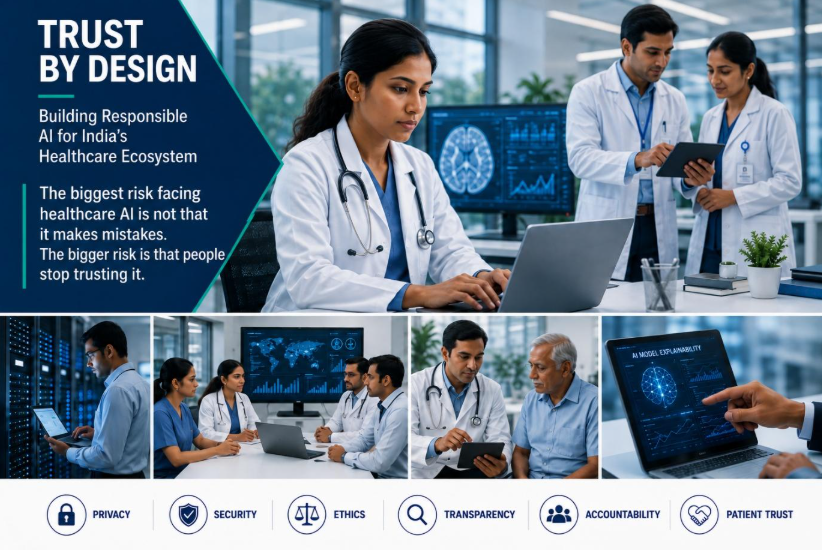
The Ninth Imperative: Design for Responsible AI from Day One
Healthcare is built on trust.
AI cannot undermine that trust.
A patient should know when AI is being used in their care where appropriate.
A doctor should understand the limitations of an AI recommendation.
A healthcare institution should know who is accountable for an AI-enabled decision.
And policymakers should have mechanisms to investigate failures.
Responsible AI therefore cannot be a compliance exercise added at the end.
It needs to be built into the architecture.
Privacy by design.Safety by design.Human oversight by design.Accountability by design.
India's existing ICMR guidelines and the Safe & Trusted AI pillar of the IndiaAI Mission provide important foundations for this direction.
The challenge now is to make these principles operational at scale.
The Tenth Imperative: Think Beyond 2047
Perhaps the most important policy question is not:
"How can India use AI in healthcare?"
It is:
"What kind of healthcare system do we want India to have by 2047—and where can AI create the greatest human value?"
That changes the conversation.
AI policy should ultimately be linked to healthcare outcomes.
Not the number of models deployed.
Not the number of GPUs installed.
Not the number of AI startups created.
But outcomes such as:
Earlier diagnosis
Better clinical decisions
Greater access
Lower costs
Improved patient experience
Better public-health surveillance
Stronger preventive care
Reduced healthcare disparities
Technology should be measured by the problems it solves.
India's 2047 Healthcare AI Opportunity
If we get the policy architecture right, India's healthcare AI ecosystem could develop along several interconnected dimensions.
AI Infrastructure
↓
Compute + Data + Digital Health Infrastructure
↓
AI Innovation
↓
Startups + Research + Healthcare Institutions + Industry
↓
AI Adoption
↓
Hospitals + Diagnostics + Pharma + Public Health
↓
AI Talent
↓
Clinicians + Engineers + Researchers + Product Leaders
↓
Trust
↓
Governance + Safety + Privacy + Accountability
↓
Global Impact
↓
Healthcare AI Solutions for India and the World
This is the ecosystem we should be building.
What This Means for Healthcare GCCs and Industry Leaders
Healthcare GCCs, pharmaceutical companies, health-tech firms, hospitals and AI startups all have a role to play in building India's healthcare AI ecosystem. The organisations that invest early in trusted data platforms, AI talent, governance frameworks and interdisciplinary innovation capabilities may be best positioned to benefit from the opportunities emerging over the next decade.
From AI Adoption to AI Leadership
India has already demonstrated that digital public infrastructure can create scale.
The next challenge is to demonstrate that AI can create equitable intelligence at scale.
The opportunity is enormous.
But we should resist the temptation to view AI in healthcare simply through the lens of technology.
The real transformation will require policy, infrastructure, talent, research, entrepreneurship, regulation and trust to move together.
India has already taken meaningful steps.
The IndiaAI Mission is building national AI capabilities. ABDM is creating digital-health infrastructure. ICMR has established ethical guidance for healthcare AI. Government programmes are already demonstrating AI applications in diagnostics, telemedicine and public-health surveillance.
The next phase is about integration and scale.
As we look towards Viksit Bharat @2047, I believe India's healthcare AI ambition should be much larger than becoming a major consumer of AI solutions.
We should aim to become a global creator, validator and exporter of responsible, scalable and affordable AI-enabled healthcare solutions.
The opportunity is not simply to build AI for India's healthcare system.
It is to build healthcare AI from India, for India—and ultimately for the world.
The policy choices we make today will determine whether that opportunity becomes reality.
My question to healthcare leaders, policymakers, technology companies and innovators is simple:
If you could prioritise only one healthcare-AI policy intervention over the next five years, what would it be and why?
I would value your perspectives.
By Ramma Shiv Kumar
#AIinHealthcare #HealthcareAI #IndiaAI #DigitalHealth #HealthcareInnovation #AILeadership #HealthcarePolicy #ResponsibleAI #FutureOfHealthcare