Why the Future of Global Pharma May Be Designed Inside GCCs, Not Headquarters

Updated: Sep 13
The Pharma & Healthcare GCC Playbook
From Capability Centres to Global Engines of Innovation, Intelligence and Patient Impact
By Ramma Shiv Kumar

The biggest risk facing Pharma GCCs is not that they fail to adopt AI.
It is that they adopt AI while continuing to operate as traditional service centres.
In a world where algorithms increasingly automate execution, GCCs will create differentiated value through capability ownership, innovation and decision influence.
The role of Global Capability Centres (GCCs) in pharma and healthcare is changing fundamentally.
For years, the GCC conversation was largely about scale, cost, talent availability and operational efficiency. Functions were moved to India, teams were built, processes were standardized and service levels improved.
That model is no longer enough.
The next generation of Pharma & Healthcare GCCs will ultimately be judged by one question:
What critical capabilities can the GCC own, build and scale for the global enterprise?
This is an important shift—from moving work to India to building capabilities in India.
And the opportunity is significant.
The 2026 India Bioeconomy Report estimates that India already has more than 150 healthcare and life sciences GCCs employing over 300,000 professionals, spanning clinical research, bioinformatics, regulatory science, analytics and digital health.
EY’s analysis shows that 23 of the world’s top 50 life sciences companies now have GCCs in India. More importantly, these centres are increasingly taking on core functions—not just enabling functions—with penetration reported at around 45% in drug discovery and development, 60% in regulatory affairs, 54% in medical affairs and 50% in commercial operations.
For nearly two decades, India's Pharma GCC story has largely been measured through scale. The next decade will be measured through capability ownership.
This reveals something far more important than GCC growth.
The Pharma & Healthcare GCC is no longer operating at the edge of the enterprise. It is moving rapidly toward its core.
The implication is profound. In the coming decade, the most valuable Pharma GCCs may not be measured by the number of employees they manage, but by the critical enterprise decisions they influence and the capabilities they create.
The question now is how to design the next generation of these centres.
1. Start With the Value Chain, Not the Org Chart
One of the most common mistakes in GCC design is to begin with functions.
Finance.IT.HR.Analytics.Operations.
That approach creates a functional centre.
A future-ready healthcare GCC should begin somewhere else:
Where in the healthcare value chain can we create differentiated global capability?
For a pharmaceutical or healthcare enterprise, that value chain can include:
Drug discovery and development
Clinical research and clinical operations
Regulatory affairs
Pharmacovigilance and patient safety
Medical affairs
Real-world evidence and analytics
Digital health
Data and AI
Manufacturing and supply-chain intelligence
Commercial analytics
Patient engagement
Product engineering
Enterprise technology
The objective should not be to transfer individual activities.
It should be to build end-to-end capability ownership.
For example, there is a significant difference between an Indian team processing clinical data and an Indian team helping design better clinical-trial strategies using advanced analytics and AI.
There is a difference between supporting regulatory documentation and building regulatory intelligence capabilities.
There is a difference between maintaining a digital platform and owning the product engineering capability behind a global healthcare product.
The second model creates strategic value.
The playbook therefore begins with value-chain mapping.
Identify the activities that are:
Critical to the enterprise
Knowledge intensive
Data rich
Technology enabled
Globally scalable
Capable of generating differentiated outcomes
These should become candidates for GCC ownership.
2. Build Five Capability Engines
A strong Pharma & Healthcare GCC should increasingly operate through a set of interconnected capability engines.
1. Data
Data engineering, data platforms, master data, clinical data, real-world data and data governance.
2. AI
AI engineering, machine learning, generative AI, responsible AI and AI-enabled workflows.
3. R&D
Drug development, clinical research, bioinformatics, computational science and scientific analytics.
4. Digital
Product engineering, digital health, cloud, automation, platforms and connected experiences.
New products, new business models, ecosystem partnerships, experimentation and emerging technology.
These should not operate as five disconnected departments.
The real opportunity lies at the intersection.
Data + AI + science + digital + talent = new healthcare capability.
That is where the GCC can move beyond being a delivery centre and become an innovation engine.
3. Make AI a Business Capability—Not an AI Project
Every healthcare organization is now discussing AI.
But buying AI tools is not the same as becoming an AI-enabled organization.
The real question is:
How does AI change the way work gets done?
Consider clinical development.
AI can potentially support patient identification, trial design, site selection, data analysis, safety monitoring and regulatory documentation.
In pharmacovigilance, AI can assist with case processing, signal detection and information synthesis.
In medical affairs, it can help connect scientific evidence, literature and field insights.
In commercial functions, it can support forecasting, segmentation and next-best-action models.
But technology alone will not create the transformation.
The operating model has to change.
That means redesigning:
Processes
Roles
Decision rights
Data flows
Technology architecture
Governance
Skills
Performance measures
The future GCC should therefore ask:
What decisions can AI improve?
rather than simply:
Where can we deploy AI?
This distinction is critical.
The best GCCs will not necessarily have the largest number of AI use cases.
They will have the highest-value AI-enabled workflows embedded into the business.
4. Move From Analytics to Decision Intelligence
Healthcare has never suffered from a complete absence of data.
The bigger challenge has often been converting data into timely, trusted decisions.
That is where the next opportunity lies.
A mature GCC should move through an evolution:
Data → Analytics → Insights → Decision Intelligence → Action
For example:
Instead of reporting clinical-trial performance, the capability should help identify where the trial is likely to face delays.
Instead of reporting supply-chain disruptions, it should help predict them and recommend mitigation.
Instead of producing commercial dashboards, it should identify changing patient or market behaviour and support decisions.
Instead of generating regulatory reports, it should build regulatory intelligence.
This is where GCCs can create substantial enterprise value.
The GCC becomes not just a producer of information, but a co-owner of decisions.
5. Talent Has to Be Redesigned Around the New Value Chain
Technology will change healthcare work.
But the most important transformation will be in the combination of skills.
The future does not belong exclusively to technologists.
Nor does it belong exclusively to scientists.
It belongs increasingly to people who can connect the two.
A clinical expert who understands AI.
A data scientist who understands healthcare.
A product leader who understands patient journeys.
A regulatory professional who understands digital technologies.
A technology leader who understands clinical development.
This is where the concept of the Healthcare AI Translator becomes important.
A Healthcare AI Translator sits between business, science and technology.
They understand the healthcare problem deeply enough to identify where AI can create value—and understand technology well enough to translate that opportunity into a viable solution.
GCC talent models should therefore increasingly combine:
Domain expertise + technology + data + AI + product thinking + business understanding.
This will require a different approach to recruitment and reskilling.
Instead of asking only:
“How many people do we need?”
GCC leaders should ask:
“What capabilities will we need to own three years from now?”
That changes the workforce planning conversation completely.
6. Build the GCC as an Innovation Ecosystem
A GCC should not exist in isolation.
The next generation of healthcare innovation will increasingly emerge from networks involving:
Global headquarters
GCCs
Universities
Research institutions
Startups
Biotech companies
Healthtech companies
CROs and CDMOs
Technology companies
Hospitals
Regulators
Patient organizations
India has an increasingly strong ecosystem to support this model.
The 2026 India Bioeconomy Report highlights the growing role of GCCs in connecting India's scientific, analytical and digital capabilities with global pharmaceutical networks. It also identifies more than 150 healthcare and life sciences GCCs and over 300,000 professionals in the ecosystem.
This creates an opportunity to build something bigger than an individual GCC.
A connected innovation ecosystem.
The GCC can become the orchestrator—connecting internal expertise with external capabilities to solve global problems faster.
7. Look at What Leading Pharma GCCs Are Already Becoming
This transformation is not theoretical.
Consider Novartis.
Its India Development organization supports global clinical operations, technical R&D, patient safety and pharmacovigilance, regulatory affairs and advanced quantitative sciences. Novartis says its India Development organization has approximately 2,400 employees, including more than 350 scientists in Technical R&D supporting pharmaceutical development.
That is very different from a conventional support centre.
It represents a deep integration of India into the global drug-development value chain.
Lilly offers another example of the direction of travel.
Its Hyderabad centre is designed around advanced technologies including AI, automation, software product engineering and cloud computing, with a focus on deep-tech capabilities supporting global operations. Lilly also describes Hyderabad as a technology hub working across data, AI, analytics and digital solutions.
These examples demonstrate an important principle:
The GCC becomes strategically valuable when it owns capabilities that the global enterprise cannot afford to be without.
8. Governance Cannot Be an Afterthought
Healthcare is different from many other industries.
The cost of getting an AI-enabled decision wrong can be significant.
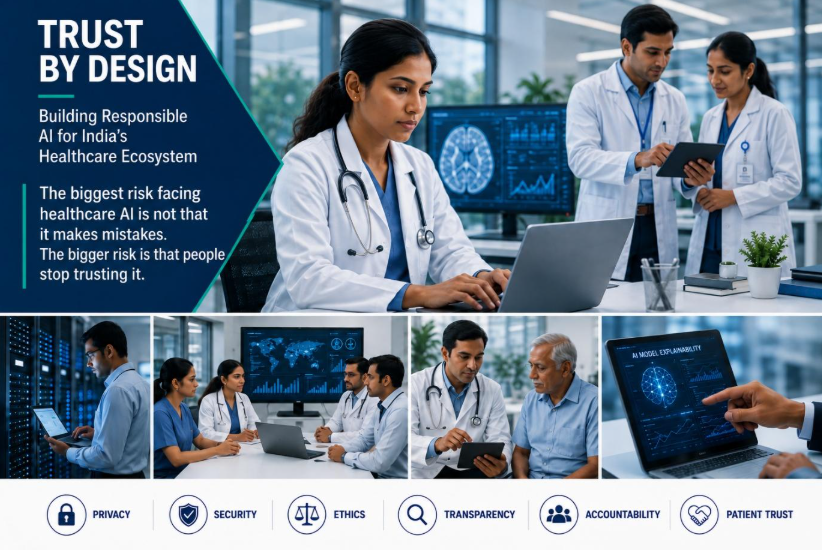
Patient safety, clinical evidence, privacy, cybersecurity, regulatory compliance, intellectual property and explainability all matter.
Therefore, governance must be designed into the operating model from the beginning.
A mature Pharma & Healthcare GCC needs clear ownership for:
Data governance
AI governance
Model validation
Cybersecurity
Privacy
Regulatory compliance
Human oversight
Intellectual property
Ethical use of AI
Auditability
The principle should be simple:
Trust by design, not trust after deployment.
This also means that healthcare AI cannot be treated purely as a technology agenda.
Medical, scientific, regulatory, legal, technology and business leaders must participate in the governance model.
9. The GCC Maturity Curve
Not every GCC needs to become an innovation hub on day one.
But every GCC should know where it is heading.
A useful maturity model is:
Stage 1 — Service Centre
Primarily executes defined processes.
Focus: Efficiency, cost, SLA performance
↓
Stage 2 — Capability Centre
Builds specialized expertise and increasingly owns complex work.
Focus: Skills, quality, scale, domain capability
↓
Stage 3 — Strategic Partner
Participates in global decisions and owns significant business outcomes.
Focus: Innovation, decision support, transformation
↓
Stage 4 — Global Innovation Engine
Creates capabilities, products and intellectual property for the global enterprise.
Focus: Enterprise value, innovation, ecosystem leadership
The objective should not simply be to move from Stage 1 to Stage 4 as quickly as possible.
The objective is to deliberately build the capabilities required for the next stage.
10. Change the GCC Scorecard
Traditional GCC metrics tend to focus on:
Cost savings
Headcount
SLA adherence
Productivity
Process efficiency
These remain relevant.
But they are no longer sufficient.
A future Pharma & Healthcare GCC should also measure:
Capability
What new capabilities have been built?
Innovation
How many ideas move from experiment to enterprise adoption?
Business impact
What decisions or outcomes has the GCC influenced?
Scientific contribution
What role does the GCC play in R&D and evidence generation?
AI adoption
How deeply is AI embedded into critical workflows?
Talent
How quickly are new skills being built?
Ecosystem
How effectively does the GCC work with startups, academia and external partners?
Patient impact
Where possible, how does the capability ultimately contribute to better patient outcomes?
The shift is therefore:
From measuring activity to measuring capability and outcomes.
11. The New Concept of “Capability Arbitrage”
India's traditional GCC advantage was often described as cost arbitrage.
That equation is changing.
The more powerful opportunity is capability arbitrage.
The question is no longer:
“Where can we perform this activity at lower cost?”
It is:
“Where can we access the combination of talent, science, technology and ecosystem required to build this capability faster and at scale?”
India has several ingredients that make this attractive:
Large scientific and technology talent pools
Strong pharmaceutical manufacturing capabilities
Growing biotech ecosystem
Digital infrastructure
AI and engineering talent
Global delivery experience
Expanding research capabilities
Large healthcare market
Growing startup ecosystem
EY's 2025 analysis similarly describes the evolution of Indian life sciences GCCs from support functions toward strategic innovation engines, with growing involvement in core functions across the life sciences value chain.
This is the foundation for the next phase.
12. The Pharma & Healthcare GCC Playbook
So what should a global pharma or healthcare organization do when designing or transforming its GCC?
I would suggest ten practical principles.
1. Start with the value chain
Identify where the enterprise needs differentiated capability.
2. Define what the GCC will own
Do not build another execution centre. Define clear global ownership.
3. Build around capabilities, not functions
Organize around outcomes and expertise rather than traditional organizational boundaries.
4. Make data foundational
AI without trusted, governed data will remain fragmented.
5. Embed AI into workflows
Move from pilots to AI-enabled business processes.
6. Build hybrid talent
Combine science, healthcare, technology, data and business expertise.
7. Create product and innovation capability
Give teams ownership of products, platforms and solutions—not just projects.
8. Design governance from day one
Especially for AI, data, patient information and regulated processes.
9. Build the ecosystem
Connect the GCC to universities, startups, research organizations and global teams.
10. Measure enterprise impact
Move beyond headcount and cost to capability, innovation, business and patient outcomes.
What Should CEOs and GCC Leaders Ask?
The most useful questions may not be:
How large should our GCC become?
or
How much cost can we save?
Five years from now, the most successful Pharma GCCs will not be measured by the number of employees they manage.
They will be measured by the number of critical enterprise decisions they influence.
That is the new definition of strategic relevance.
Instead, ask:
Which parts of our global healthcare value chain should India own?
What capabilities do we want to build here that do not exist elsewhere?
Which R&D and scientific activities can be globally anchored in India?
Where can AI fundamentally redesign work?
What talent combinations will we need five years from now?
Are our data foundations ready for AI at scale?
What decisions should the GCC increasingly co-own?
What innovation should originate from the GCC rather than simply be implemented by it?
How connected is our GCC to India's research and startup ecosystem?
What would make the global business consider our GCC indispensable?
These questions change the conversation from “setting up a GCC” to “building a strategic global capability.”
The Next GCC Will Be Designed Differently
The evolution of Pharma & Healthcare GCCs is not simply another chapter in the outsourcing story.
It is part of a broader redesign of how global healthcare companies access talent, science, technology and innovation.
India's GCC ecosystem is already demonstrating this transition.
The 2026 India Bioeconomy Report places India at more than 150 healthcare and life sciences GCCs and over 300,000 professionals, while EY's research shows that leading life sciences companies are increasingly embedding core scientific and commercial responsibilities within Indian GCCs.
The next step is to make that capability intentional.
A GCC should not be designed simply to receive work.
It should be designed to build capability.
It should not only execute processes.
It should improve them.
It should not only consume technology.
It should create and shape technology.
It should not simply provide analytics.
It should influence decisions.
And it should not operate at the edge of the healthcare value chain.
It should increasingly sit at its centre.
From Service Centre → Capability Centre → Strategic Partner → Global Innovation Engine.
That is the real Pharma & Healthcare GCC playbook.
And for India, the opportunity is bigger still.
The opportunity is not merely to become the preferred location for global healthcare operations.
It is to become one of the places where the future of global healthcare is designed, developed and scaled.
About SRK GameChangers
At SRK GameChangers, we believe the next generation of GCCs will be built around capability, ownership and measurable enterprise value—not simply scale.
For Pharma & Healthcare organizations, this means designing GCCs around the value chain, future talent, AI readiness, operating models, governance and innovation ecosystems.
The question is no longer whether India can support the global healthcare enterprise.
The question is: what part of the global healthcare enterprise can India help build next?
I would love to hear from pharma leaders, GCC heads, R&D executives and healthcare innovators:
Which capability do you believe will define the next generation Pharma GCC?
AI & Decision Intelligence
Clinical & R&D Innovation
Regulatory Intelligence
Digital Health
Product Engineering
Patient Analytics
Share your views in the comments.
#PharmaGCC #HealthcareGCC #GlobalCapabilityCentres #LifeSciences #HealthcareInnovation #AIinHealthcare #IndiaGCC #PharmaInnovation