Reimagining Healthcare Value Chain and Talent

Updated: Aug 29
How India Can Build AI-Native Healthcare Capabilities Through a New Operating Model
By Ramma Shiv Kumar

India is no longer merely discussing whether AI belongs in healthcare.
The strategic conversation has moved to implementation, capability building and scale.
That shift is visible across the ecosystem.
India launched the Strategy for Artificial Intelligence in Healthcare for India (SAHI) and the Benchmarking Open Data Platform for Health AI (BODH) at the India AI Impact Summit in February 2026. BODH, developed by IIT Kanpur in collaboration with the National Health Authority, is designed to benchmark AI models using diverse, anonymised real-world health data and assess performance, robustness, bias and generalisability before deployment at scale.
The numbers behind India's digital-health infrastructure are equally significant.
As of 20 July 2026, India had created 94.87 crore ABHA IDs, with 5.36 lakh health facilities and 10.09 lakh healthcare professionals registered under the Ayushman Bharat Digital Mission.
These are not simply technology statistics.
They represent the foundations of a potential AI-enabled healthcare operating environment.
And that leads to a much bigger question for healthcare, pharmaceutical and life-sciences leaders:
Are we simply adopting AI—or are we redesigning the healthcare value chain around AI?
I believe the distinction will increasingly determine who creates lasting advantage.
The Opportunity Is Bigger Than AI Adoption
Healthcare has always depended on the combination of technology and human expertise.
But AI is changing more than individual processes.
It is changing:
How healthcare work is designed
How decisions are made
How knowledge is connected
Where capabilities are built
How talent is organised
How regulatory systems operate
How innovation moves from pilot to scale
For India, the opportunity is even bigger.
The objective should not simply be to become a large market for healthcare technology.
India should deliberately build AI-native healthcare capabilities that can serve India and the world.
This requires a new operating model spanning five connected dimensions:
Healthcare Value Chain
Talent
Global Capability Centres
Governance & Trust
Innovation Ecosystem
The technology is only one layer.
The operating model around it will determine whether AI creates real value.
The New Healthcare AI Operating Model
The healthcare organisations that lead the next phase will increasingly operate across five interconnected layers:
1. VALUE CHAIN
Research → Discovery → Clinical → Regulatory → Manufacturing → Care → Patient
2. TALENT
Clinicians + Scientists + Engineers + Data Specialists + AI Translators
3. GCCs
Global AI + Product + Research + Regulatory + Analytics Capabilities
4. GOVERNANCE
SAHI + BODH + DPDP + Clinical Validation + Global Regulatory Principles
5. INNOVATION
Startups + Universities + Hospitals + Pharma + Technology + Government
The competitive advantage will come from connecting these five layers.
From Digital Healthcare to Intelligent Healthcare
For the past two decades, healthcare organisations have invested heavily in digitisation.
Electronic health records replaced paper.
Digital imaging transformed diagnostics.
Laboratory systems became increasingly automated.
Pharmaceutical companies digitised clinical and regulatory workflows.
Hospitals adopted digital scheduling, billing and patient-management systems.
India's digital-health infrastructure has now reached significant scale.
ABDM had crossed 90 crore ABHA accounts by May 2026, alongside more than 100 crore linked health records, creating one of the world's largest digital-health ecosystems.
The next phase is fundamentally different.
The transition is:
Digital Healthcare → Intelligent Healthcare
Digital systems primarily help organisations capture, store and exchange information.
AI can potentially help them interpret, predict, recommend and act on information.
A diagnostic system does not merely store an image.
AI can assist clinicians in identifying patterns.
A pharmaceutical company does not simply manage research data.
AI can help researchers connect information across discovery, clinical development, regulatory intelligence and pharmacovigilance.
A hospital does not merely maintain patient records.
AI can potentially help clinicians and administrators derive intelligence from patient histories, workflows and operational data.
The strategic opportunity is therefore not to add AI to existing processes.
It is to redesign the processes themselves.
The Healthcare Value Chain Is Becoming an Intelligence Chain
The traditional healthcare value chain is relatively fragmented:
Research → Drug Discovery → Clinical Development → Diagnostics → Manufacturing → Care Delivery → Patient Engagement
AI can potentially connect intelligence across these stages.
Imagine a model where insights generated during clinical research inform regulatory intelligence; where real-world evidence informs product development; where diagnostic information contributes to longitudinal patient intelligence; and where patient-level insights can support preventive care.
The objective is not simply to make individual processes faster.
It is to create a more connected healthcare intelligence system.
This is where India has an opportunity to build differentiated capability.
India's pharmaceutical industry already provides a powerful foundation.
The country ranks third globally by pharmaceutical volume and 11th by value, with more than 3,000 pharmaceutical companies and 10,500 manufacturing units. India supplies around 20% of global generic medicines, while the domestic pharmaceutical market is projected to grow from approximately US$60 billion to US$130 billion by 2030.
The next opportunity is to add an AI capability layer to this existing scale.
Diagnostics: From Detection to AI-Augmented Decision Making
Diagnostics is one of the clearest examples of where AI can reshape healthcare.
Medical imaging, pathology, genomics and laboratory diagnostics generate enormous volumes of information.
AI can support:
Pattern recognition
Risk identification
Image interpretation
Triage
Decision support
Workflow prioritisation
But the most important shift is not replacing clinical expertise.
It is augmenting it.
The clinician brings:
Context
Experience
Clinical judgement
Patient understanding
Ethical responsibility
AI can contribute:
Speed
Scale
Pattern recognition
Data analysis
Consistency
Decision support
The future is therefore not:
Doctor versus AI.
It is:
Doctor + AI.
The operating model must be designed around that relationship.
Pharma: From Data-Rich to AI-Native
The pharmaceutical industry provides an even broader opportunity.
AI can potentially influence:
Drug discovery
Molecular analysis
Clinical trial design
Patient recruitment
Clinical documentation
Pharmacovigilance
Regulatory intelligence
Manufacturing
Commercial analytics
But pharmaceutical organisations should not approach AI simply as a collection of use cases.
They should think about how scientific and regulatory knowledge is organised across the enterprise.
That question is becoming particularly relevant as regulators themselves digitise.
In July 2026, CDSCO Drugs Controller General Dr Rajeev Singh Raghuvanshi announced plans for the first phase of an end-to-end Digital Drug Regulatory System (DDRS) within 18 months. The proposed platform is intended to connect the regulatory value chain from research and clinical development through manufacturing, approvals, distribution and post-market surveillance. CDSCO is also piloting AI across regulatory processes.
This is an important signal.
The regulatory ecosystem itself is becoming digital and increasingly intelligence-driven.
Pharma companies therefore need to rethink regulatory capability—not as a back-office function, but as part of their AI-enabled operating model.
A New Regulatory Reality
The regulatory landscape for AI-enabled healthcare is evolving quickly.
Three developments deserve particular attention.
SAHI
The Strategy for Artificial Intelligence in Healthcare for India, launched in February 2026, provides national direction for safe, ethical, evidence-based and inclusive AI adoption across India's healthcare system. It addresses areas including governance, data stewardship, validation, deployment and monitoring.
BODH
The Benchmarking Open Data Platform for Health AI creates a structured mechanism to evaluate AI models before population-scale deployment, including performance, robustness, bias and generalisability.
This matters because the next question after:
"Can the model work?"
is:
"Can the model work reliably across India's diverse healthcare environments?"
CDSCO Digital Regulatory System
The proposed DDRS points towards a more integrated, digital regulatory ecosystem across the pharmaceutical value chain.
CDSCO has also been piloting AI for activities including application pre-screening, reviewer allocation, inspections and regulatory processes.
These developments indicate something important:
Healthcare AI is moving from experimentation towards institutionalisation.
Healthcare leaders need to prepare accordingly.
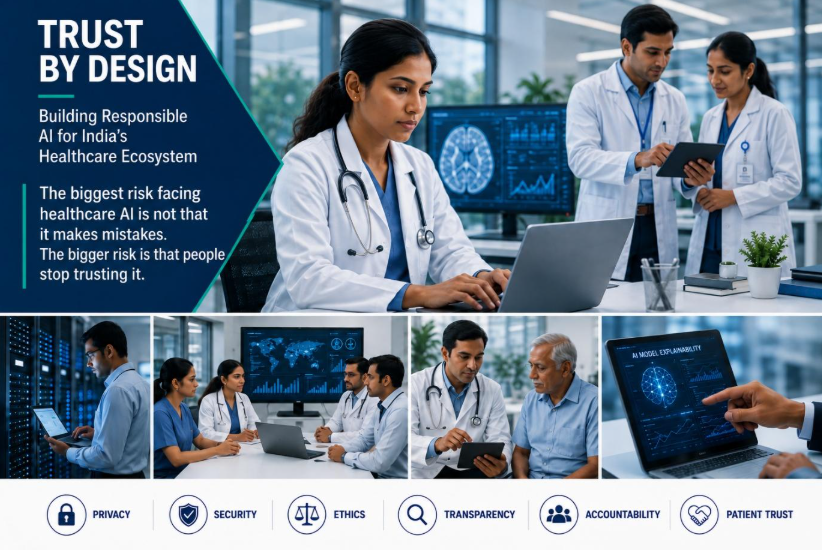
Trust Will Become an Operating Capability
AI in healthcare cannot be separated from trust.
Patient information is highly sensitive.
Clinical decisions carry consequences.
AI models can introduce bias.
Models can degrade over time.
And responsibility cannot disappear simply because an algorithm is involved.
India's Digital Personal Data Protection Rules, 2025, notified in November 2025, provide the broader data-protection framework within which organisations will increasingly need to manage personal data. The Rules include provisions around clear notice, informed consent and data-security obligations, with a phased implementation timeline.
For healthcare organisations, this means data governance can no longer sit separately from AI strategy. It must become part of the operating model.
The question should not be:
"Are we compliant?"
It should be:
"Have we designed AI so that privacy, security, accountability and human oversight are built into the system?"
That is the difference between compliance and responsible AI architecture.
Global Regulatory Signals Are Moving in the Same Direction
The global pharmaceutical ecosystem is also establishing clearer expectations.
On 14 January 2026, the US FDA and European Medicines Agency jointly released 10 guiding principles for good AI practice in drug development.
The principles include:
Human-centric design
Risk-based approaches
Appropriate standards
Clear context of use
Multidisciplinary expertise
Data governance and documentation
Robust model development
Risk-based performance assessment
Lifecycle management
Clear and essential information
The direction is clear.
AI in healthcare is moving towards an environment where evidence, context, governance and lifecycle management matter as much as algorithmic performance.
Indian healthcare companies that aspire to build solutions for global markets should design for these expectations from the beginning.
The Most Important Shift: Redesign the Work
This may ultimately be the most important leadership question.
The conversation around AI often starts with:
"Which jobs will AI replace?"
I believe healthcare leaders should ask a different question:
"How will AI change the way this job is performed?"
That is a much more useful question.
A regulatory professional may spend less time manually reviewing documents and more time evaluating complex regulatory questions.
A radiologist may spend less time on repetitive image analysis and more time on difficult diagnoses and patient interaction.
A pharmaceutical researcher may spend less time searching through information and more time evaluating scientific possibilities.
A healthcare operations manager may spend less time compiling reports and more time making decisions based on real-time intelligence.
A nurse may spend less time on documentation and more time with patients.
This is work redesign, not simply automation.
And it has significant implications for talent strategy.
The Rise of the Healthcare AI Translator
One of the most important talent categories of the future may be what I call the:
Healthcare AI Translator
This is not necessarily a doctor who becomes a data scientist.
Nor is it a data scientist who becomes a doctor.
It is a professional who understands enough of:
Healthcare + AI + Data + Business + Regulation
to connect specialists across those domains.
Healthcare AI Translators can potentially bridge:
Clinicians and data scientists
Researchers and technology teams
Business leaders and AI specialists
Regulators and product teams
GCC teams and global business units
Their value lies in connecting knowledge and translating business or clinical problems into scalable AI opportunities.
India has a natural advantage here.
The country has large pools of:
Healthcare professionals
Engineers
Data scientists
Technology specialists
Pharmaceutical professionals
Regulatory experts
Product managers
The opportunity is to connect these talent pools rather than develop them in isolation.
The Healthcare GCC Must Change Too
This is where India's GCC opportunity becomes particularly interesting.
Healthcare GCCs have traditionally supported global organisations through functions such as:
Finance
HR
IT
Analytics
Operations
Customer support
AI changes the mandate.
The future healthcare GCC could increasingly become a global healthcare intelligence and innovation capability.
Its mandate could include:
AI and analytics
Clinical technology
Regulatory intelligence
Digital health
Data engineering
Research support
Product engineering
Cybersecurity
AI governance
Healthcare innovation
The question for global healthcare companies should increasingly become:
"How can our India GCC help us build the future of healthcare?"
rather than:
"Which processes can we move to India?"
That is a fundamentally different GCC conversation.
Case Study: Apollo's Emerging AI Operating Model
A useful Indian example is the evolution of Apollo Hospitals' AI capability.
Apollo's 2025–26 annual report describes an AI ecosystem that goes beyond isolated pilots.
Apollo Clinical AI Labs has developed a portfolio of 20 clinical decision-support APIs, with AI applications spanning imaging, risk scoring, acute-care pathways and clinical documentation.
The organisation reports 3.5 million+ patient API transactions processed across AI-led pathways, while its AI-LF platform for liver-fibrosis risk assessment has supported more than 150,000 prospective clinical assessments and reported validation accuracy above 93%.
Perhaps more importantly, Apollo describes an ecosystem involving more than 60 global partners, including academic institutions, technology companies, research organisations and healthcare networks.
This is instructive because the lesson is not simply:
"Apollo is using AI."
The more important lesson is the operating model emerging around AI:
Clinical expertise + AI engineering + longitudinal data + validation + regulatory capability + partnerships + scale
That is what an AI-native healthcare capability begins to look like.
The lesson for other healthcare organisations is clear:
AI leadership is an organisational design challenge—not a technology procurement exercise.
What This Means for India's GCCs
The Apollo example also illustrates a broader opportunity for India.
Global healthcare companies can increasingly use India not only for technology delivery, but for building global AI-enabled healthcare capabilities.
An AI-native healthcare GCC could potentially own:
Value Chain Intelligence
Connecting research, clinical, regulatory and commercial information.
AI Product Engineering
Building and scaling global healthcare AI products.
Clinical & Regulatory Intelligence
Supporting evidence generation, regulatory submissions and pharmacovigilance.
AI Workforce Development
Creating healthcare professionals with AI fluency and technology professionals with healthcare expertise.
Responsible AI
Building governance, validation and monitoring capabilities.
Innovation
Working with startups, universities, hospitals and research institutions.
This moves the GCC conversation from cost and capacity to capability and intellectual property.
India's Opportunity Is an Ecosystem Opportunity
India already has many of the ingredients.
The country has a large technology workforce.
It has a globally significant pharmaceutical industry.
It has an expanding digital-health infrastructure.
It has healthcare startups.
It has Global Capability Centres.
It has academic and research institutions.
It now also has emerging national AI-health infrastructure through initiatives such as SAHI and BODH.
But these capabilities need to connect.
The July 2026 collaboration between WHO South-East Asia and the Max Institute of Healthcare Management at ISB is an interesting example of this direction. The initiative focuses on responsible and evidence-driven AI adoption through decision frameworks, implementation studies, partnerships, infrastructure and capacity building.
That is precisely the type of ecosystem thinking India needs.
Five Priorities for Healthcare Leaders
The next phase of AI adoption requires healthcare leaders to move from experimentation to operating-model design.
I would suggest five priorities.
1. Start With the Value Chain
Don't begin with:
"Where can we use AI?"
Begin with:
"Where in our value chain is intelligence the constraint?"
Then identify the AI opportunities.
2. Redesign Work Before Automating It
Map how work is performed today.
Then determine:
What AI can automate
What AI can augment
What humans should continue to own
What new roles will emerge
This creates a more realistic AI workforce strategy.
3. Build the Healthcare AI Translator Capability
Identify individuals who can bridge clinical, technological, business and regulatory domains.
This capability will become increasingly valuable as AI moves from experimentation into enterprise deployment.
4. Build Governance Into the Operating Model
Use the emerging Indian and global frameworks—SAHI, BODH, DPDP and the FDA–EMA principles—as reference points for building internal AI governance.
Governance should cover:
Data → Model → Validation → Deployment → Monitoring → Accountability
Not just model approval.
5. Reimagine the GCC
For global healthcare companies, ask whether the India GCC can own:
AI products
Clinical intelligence
Regulatory intelligence
Data platforms
Research capabilities
AI governance
Innovation
The objective should be to build global capability from India, not simply relocate work to India.
From AI Adoption to AI Leadership
India has reached an interesting moment.
The digital foundations are increasingly in place.
The policy conversation has matured.
The regulatory ecosystem is evolving.
AI benchmarking mechanisms are emerging.
Healthcare and pharmaceutical organisations are beginning to move beyond pilots.
And India's GCC ecosystem is increasingly capable of owning complex global work.
The opportunity now is to bring these pieces together.
The next healthcare advantage will not come from having the most AI tools.
It will come from building the right operating model around AI.
An operating model where:
AI augments clinical expertise.
Talent is redesigned around human-AI collaboration.
GCCs become global capability engines.
Governance creates trust rather than friction.
Innovation moves from pilot to scale.
And most importantly, where the healthcare value chain becomes increasingly intelligent, connected and responsive.
India should not aspire merely to become a country where global healthcare companies deploy AI.
We should aspire to become a country where global healthcare companies build AI-native healthcare capabilities.
That is a much bigger ambition. And potentially, a much bigger opportunity.
The question for healthcare leaders is therefore not:
"How much AI should we adopt?"
It is:
"What operating model do we need to build so that AI can create measurable value across our healthcare value chain—and how can India become the capability engine for that transformation?"
I would be keen to hear from healthcare, pharma, technology and GCC leaders:
Which part of this operating model—value chain, talent, GCCs, governance or innovation—do you believe India needs to strengthen most urgently?
By Ramma Shiv Kumar
#AIinHealthcare #HealthcareAI #IndiaAI #DigitalHealth #HealthcareInnovation #HealthcareGCC #GCCLeadership #AILeadership #ResponsibleAI #FutureOfHealthcare